

James River Blog
Standard 3 Point Hitch vs. John Deere iMatch vs. Telescoping Draft Links: Which Setup Is Best?
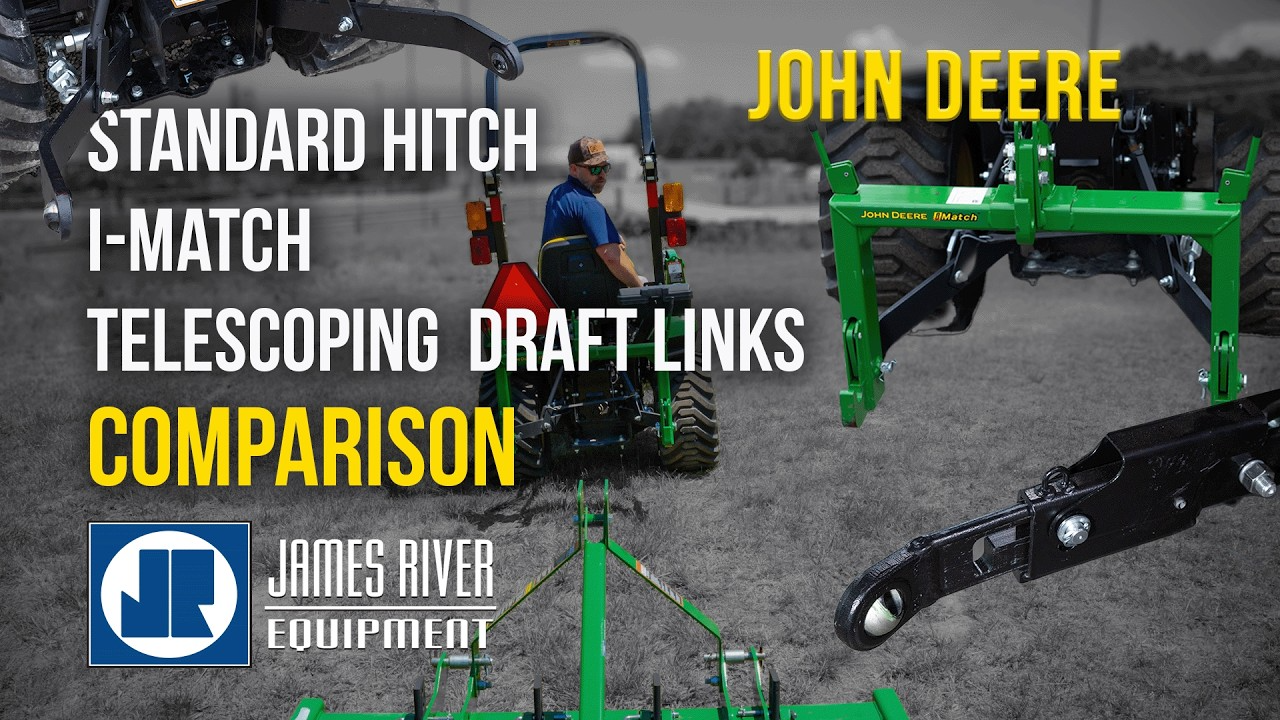
The best 3-point hitch setup depends on how often you change implements and the type of work you do. A standard 3-point hitch is simple and effective, telescoping draft links make implement hookups easier, and the John Deere iMatch Quick Hitch can significantly reduce hookup time for operators who frequently switch between attachments.
At James River Equipment, one of the most common frustrations we hear from tractor owners involves connecting and disconnecting implements. Whether you're swapping between a rotary cutter, box blade, landscape rake, tiller, or spreader, choosing the right hitch setup can save time, reduce effort, and make your tractor more enjoyable to operate.
In this guide, we'll compare the standard 3-point hitch, John Deere iMatch Quick Hitch, and telescoping draft links to help you determine which option best fits your operation.
How Does a Standard 3-Point Hitch Work?
The traditional 3-point hitch remains the most common implement connection system found on compact and utility tractors.
It uses:
- Two lower lift arms
- One upper top link
- Lift arms powered by the tractor's hydraulic system
The system creates a secure connection between the tractor and implement while allowing the attachment to be raised, lowered, and controlled during operation.
Benefits of a Standard 3-Point Hitch
A standard setup offers several advantages:
- Simple design
- Wide implement compatibility
- Lower upfront cost
- Reliable operation
- Familiarity for most tractor owners
Because most implements are designed around the traditional 3-point hitch standard, compatibility is rarely a concern.
What Are the Downsides of a Standard 3-Point Hitch?
While effective, connecting implements manually can be time-consuming.
Common challenges include:
- Aligning lift arms with implement pins
- Repeatedly getting on and off the tractor
- Moving heavy implements into position
- Difficulty connecting attachments on uneven ground
For owners who only switch implements occasionally, these extra steps may not be a major concern. However, operators who change attachments frequently often look for ways to simplify the process.
What Is the John Deere iMatch Quick Hitch?
The John Deere iMatch Quick Hitch is designed to streamline implement hookups by creating a standardized connection point between the tractor and compatible implements.
Instead of manually connecting each lower lift arm and top link, the operator can often back into the implement and secure all three hitch points in a single motion.
How Does the iMatch Quick Hitch Save Time?
The biggest advantage is efficiency.
With compatible implements, operators can:
- Connect attachments faster
- Reduce manual adjustment
- Spend less time outside the tractor
- Switch implements more frequently
- Improve productivity throughout the day
For customers managing multiple implements, the time savings can add up quickly.
Is the John Deere iMatch Worth It?
Who Benefits Most from an iMatch Quick Hitch?
The iMatch often makes the most sense for operators who regularly switch between:
- Rotary cutters
- Finish mowers
- Box blades
- Landscape rakes
- Tillers
- Spreaders
- Rear blades
If you're changing implements multiple times each week, a quick hitch can dramatically simplify your workflow.
At James River Equipment, many customers tell us the iMatch becomes one of their favorite tractor upgrades because of the convenience it adds to everyday tasks.
What Implement Compatibility Should You Consider?
Before purchasing an iMatch Quick Hitch, compatibility matters.
Ask yourself:
- Are my current implements quick-hitch compatible?
- Will future implements meet iMatch specifications?
- Do any attachments require adapters or modifications?
Understanding compatibility before making a purchasing decision helps avoid surprises later.
What Are Telescoping Draft Links?
Telescoping draft links are an upgraded lower-link design commonly found on certain compact and utility tractors.
Unlike fixed hitch arms, telescoping links can extend outward temporarily during implement hookup.
This allows operators to connect the implement first and then retract the links into their operating position.
How Do Telescoping Draft Links Make Hookups Easier?
The added flexibility reduces the need for perfect tractor alignment.
Benefits include:
- Easier implement hookups
- Less repositioning of the tractor
- Reduced physical effort
- Faster connections on uneven terrain
- Improved convenience with larger implements
For many operators, telescoping draft links provide much of the hookup convenience they're looking for while maintaining full compatibility with traditional implements.
iMatch vs. Telescoping Draft Links: What's the Difference?
While both systems simplify implement connections, they do so in different ways.
iMatch Quick Hitch
Best known for:
- Fast implement changes
- Reduced hookup time
- Minimal manual adjustment
- Excellent convenience for compatible implements
Telescoping Draft Links
Best known for:
- Easier alignment
- Broad implement compatibility
- Flexibility in the field
- Simpler hookups without requiring quick-hitch compatibility
The right choice depends on your equipment lineup and how often you swap attachments.
Which Setup Is Best for Different Applications?
For Operators Who Rarely Change Implements
A standard 3-point hitch may be all you need.
It offers:
- Maximum compatibility
- Lower cost
- Proven simplicity
If you're leaving a mower or other attachment connected for extended periods, additional hookup features may provide limited benefit.
For Property Owners with Multiple Implements
An iMatch Quick Hitch can save significant time.
It's particularly helpful for operators who regularly switch between:
- Mowing
- Grading
- Landscaping
- Food plot preparation
- Driveway maintenance
The more often you change attachments, the more valuable the quick hitch becomes.
For Larger Implements or Uneven Ground
Telescoping draft links often shine when:
- Implements are heavier
- Ground conditions vary
- Hookups occur on uneven surfaces
- Precise tractor positioning is difficult
Many operators appreciate having a little extra flexibility during the hookup process.
Can You Have Both iMatch and Telescoping Draft Links?
In many cases, yes.
Depending on the tractor model and configuration, operators may benefit from both systems.
This combination can provide:
- Faster hookups
- Easier alignment
- Greater convenience
- Reduced operator frustration
For customers who frequently use multiple implements, combining both features may create the best overall experience.
How Do These Systems Improve Productivity?
One of the easiest ways to increase productivity isn't necessarily adding horsepower. Sometimes it's reducing the time spent changing attachments.
Efficient implement hookups can help:
- Reduce downtime
- Complete jobs faster
- Encourage proper implement usage
- Improve operator comfort
- Increase overall tractor versatility
When attachment changes become easier, operators are more likely to use the right tool for each task.
Which 3-Point Hitch Setup Should You Choose?
The answer depends on your operation.
Choose a Standard 3-Point Hitch If:
- You rarely change implements
- Maximum compatibility is your priority
- You prefer a simple setup
- You're working within a tighter budget
Choose an iMatch Quick Hitch If:
- You frequently swap attachments
- Convenience is a priority
- Your implements are quick-hitch compatible
- You want to minimize hookup time
Choose Telescoping Draft Links If:
- You regularly connect larger implements
- You work on uneven terrain
- You want easier hookups without changing implement compatibility
- You prefer more flexibility during alignment
At James River Equipment, we often help customers evaluate not only the tractor they're purchasing, but also the implements they'll use throughout the year. The best hitch setup is the one that matches your equipment, workflow, and long-term goals.
Common Questions About 3-Point Hitch Systems
What is the advantage of an iMatch Quick Hitch?
The primary advantage is faster implement changes. Compatible implements can often be connected with significantly less manual effort compared to a traditional 3-point hitch setup.
Do all implements work with an iMatch Quick Hitch?
Not necessarily. Some implements are designed to be quick-hitch compatible, while others may require modifications or adapters.
What do telescoping draft links do?
Telescoping draft links extend outward during hookup, making it easier to align and connect implements without perfect tractor positioning.
Are telescoping draft links worth it?
For many operators, yes. They can simplify attachment hookups, especially when working with heavier implements or uneven terrain.
Which system is best for homeowners with compact tractors?
Many compact tractor owners benefit from either telescoping draft links or an iMatch Quick Hitch, depending on how frequently they change implements and what attachments they use.
Can I add an iMatch Quick Hitch later?
In many cases, yes. Many tractor owners start with a standard 3-point hitch and add an iMatch Quick Hitch as their implement collection grows.
What is the fastest way to connect tractor implements?
For compatible attachments, an iMatch Quick Hitch is often the fastest solution. Telescoping draft links can also significantly reduce hookup time and effort compared to a standard fixed-arm setup.
Whether you're mowing, grading driveways, preparing food plots, maintaining pastures, or handling landscaping projects, the right hitch setup can make every implement change faster and easier. If you're considering an iMatch Quick Hitch, telescoping draft links, or a new tractor package, the team at James River Equipment can help you choose the configuration that best fits your operation.
Go Back to List
- Blog Archive
- Construction Equipment Rental vs. Buying: How to Choose the Right Option for Your Next Job
- Restoring a 1958 John Deere 440: The Teamwork Behind a 100th Anniversary Project
- Meet the New John Deere Z550R, Z560R, and Z565R: Premium Comfort with FlexGlide TM Suspension
- Preventative Maintenance for Construction Equipment: The Key to More Uptime and Lower Operating Costs
- How to Use the Topcon LN-160 Layout Navigator for Faster, More Accurate Jobsite Layout
- James River Equipment Earns First John Deere Onyx Circle Award During Centennial Year
- Henderson Incorporated and James River Equipment: A Partnership Built on Trust
- James River Equipment Opens New Mills River Facility to Better Serve Western North Carolina
- MHI: From Renting Equipment to Running a Full Fleet Across Five States
- John Deere AutoTrac(TM) Vision 2.0: Smarter Spraying, Better Visibility, and Increased Productivity
- Standard 3-Point Hitch vs. John Deere iMatch vs. Telescoping Draft Links: Which Setup Is Best?
- John Deere Riding Mower Comparison: S100, S200, X300, X500, and X700 Series
- John Deere 1023E vs. 1025R: Which 1 Series Tractor Is Right for You?
- KRONE Vendro 560 Tedder: Features, Benefits, and Is It the Right Tedder for Your Farm?
- Custom John Deere 5120M Outlaw Tractor: Built for Steep Slopes, Rough Terrain, and Extreme Off-Road Work